
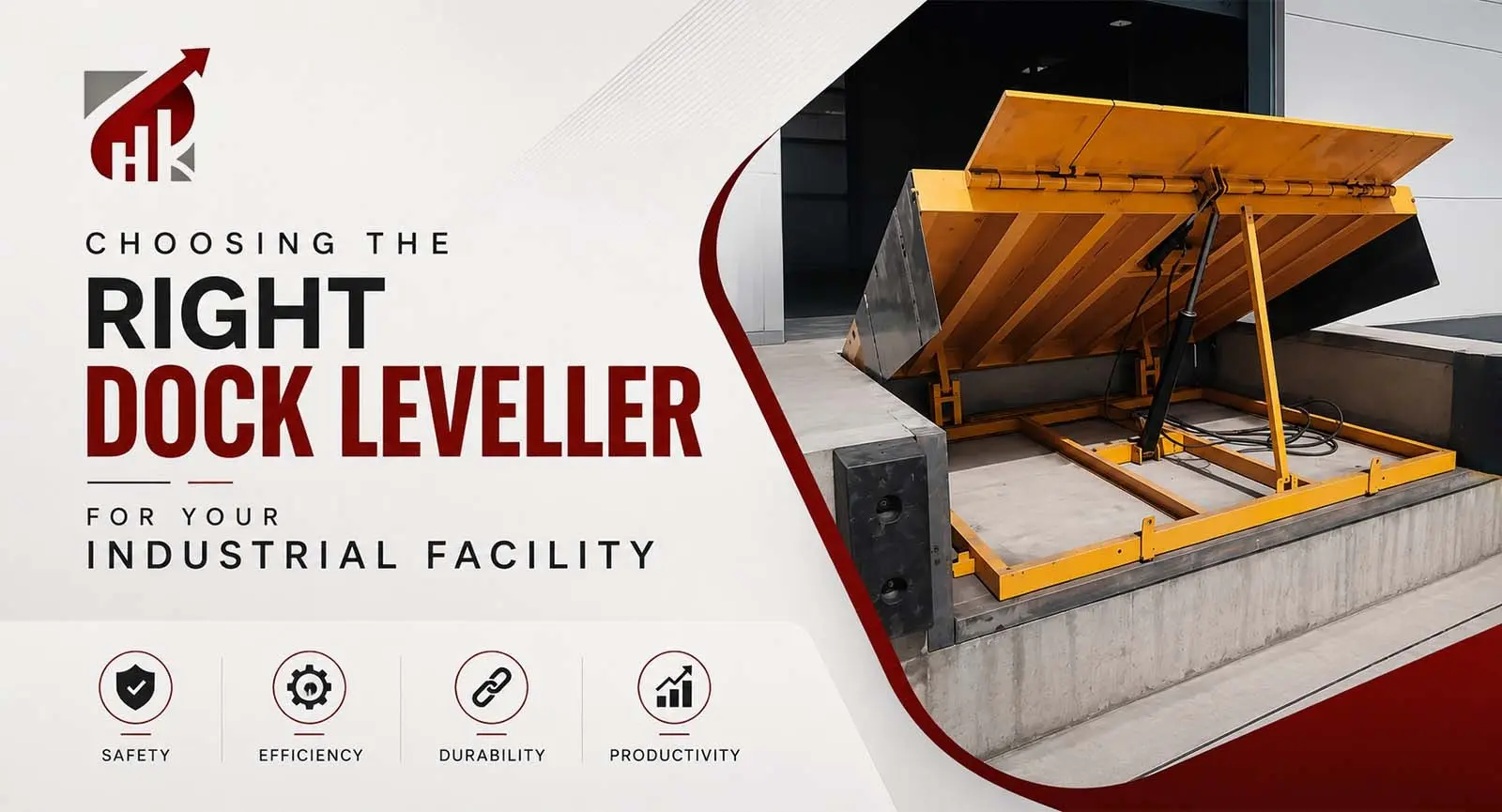
A loading dock that runs well keeps everything else on track. Goods move in and out on time, forklifts cross between the warehouse and the truck without issues, and the team gets through each shift without unnecessary delays or safety concerns. The dock leveler is what makes that possible. It is at the edge of the dock and bridges the height gap between the warehouse floor and the truck trailer. Every truck that pulls in is at a slightly different height because of load weight, tyre pressure, or trailer design. This leveler compensates for that difference, allowing loading and unloading to proceed safely and efficiently. This article covers every type of dock leveler, what each one suits, key specifications, use cases, and what to look for in a dock leveler manufacturer or supplier before making a decision.
The Main Types of Dock Levelers
Not every leveler is built the same way. Each type has a different operating mechanism, and each one suits a different kind of facility. Let’s discuss some of the different types of dock levelers:
- Mechanical Dock Levelers: The operator pulls a release chain, the platform rises, and they manually walk it down onto the truck bed. No electricity is required for this.
These are the most affordable options and the simplest to maintain. They have fewer parts, which means fewer things that can go wrong. For smaller facilities with lower traffic volumes, a mechanical dock leveler is a practical and cost-effective choice.
The main drawback is that they require physical effort from the operator on every cycle. On a busy dock running multiple shifts, that adds up. - Hydraulic Dock Levelers: The operator presses a button. The platform rises, the lip extends, and the leveller lowers itself onto the truck bed, all automatically. The whole sequence takes seconds.
Hydraulic dock levelers are the most widely used type across industrial facilities worldwide. They are fast, consistent, and significantly reduce the physical demand on dock staff. According to industry data, hydraulic levellers account for over 60% of all new dock leveler installations globally.
They cost more than mechanical types and require regular servicing. But for medium to high-volume operations, the speed and reliability they deliver justify the investment. - Pneumatic Dock Levelers: These work on a simple airbag system. The bag inflates to raise the platform and deflates to lower it. No hydraulic fluid involved.
That last point matters in food processing and cold storage environments, where hydraulic fluid contamination is a genuine concern. Pneumatic levellers are reliable, low-maintenance, and energy efficient, making them a strong choice for hygiene-sensitive operations. - Vertical Storing Dock Levelers: Most levellers lie flat in a pit when not in use. A vertical storing leveller stands upright against the dock door instead. When the door closes, the leveller seals the pit completely.
This creates a full barrier against outside air, pests, water, and debris, which makes a difference in refrigerated warehouses and cold chain facilities. The energy savings from better thermal sealing add up over time, and these levellers often recover their higher installation cost within a few years of operation. - Edge-of-Dock Levelers: These mount directly to the dock face rather than sitting in a pit. No pit construction is needed, which keeps installation simple and costs low.
They handle smaller height differences, typically within 75mm above or below dock height. They suit lighter operations where trailer heights are fairly consistent and a full pit-mounted leveller is not needed.
Key Specifications: Explained Simply
When comparing options from different dock leveler manufacturers, these are the figures worth understanding:
Specification | What to Know |
Capacity | The maximum load the leveller handles safely, typically 6,000 kg to 10,000 kg |
Working range | How much height difference can it adjust for, usually ±300mm |
Platform width | Should match or exceed the dock door width, standard sizes 1,800mm to 2,000mm |
Platform length | Longer platforms create a shallower, safer ramp for forklifts |
Lip length | The section that rests on the truck bed is usually 400mm to 600mm |
Cycle time | How fast does a powered leveller complete one full operation |
Operating temperature | Important for levellers used in cold storage conditions |
One point worth noting on platform length, a leveller with a short platform creates a steep ramp angle, even if the capacity rating looks fine on paper. Steep ramps are harder for forklift operators to manage and add wear to both the equipment and the truck. Longer platforms make the crossing safer and smoother.
Where Dock Levelers Are Used
Dock levelers are used across almost every sector that involves regular loading and unloading:
- Warehousing and logistics: The core application, handling palletised goods moved by forklifts across multiple daily shifts.
- Cold storage and food processing: Where hygiene, contamination control, and thermal efficiency drive equipment selection.
- Manufacturing plants: For receiving raw materials and dispatching finished products.
- Retail distribution centres: High-frequency docks with several loading bays operating at the same time.
- Pharmaceutical facilities: Here, precise handling, cleanliness, and regulatory compliance all matter.
- E-commerce fulfilment centres: Fast-moving operations that need reliable, quick-cycling equipment around the clock.
The global material handling equipment market was valued at USD 214 billion in 2023. Loading dock equipment, including dock levelers, makes up a significant part of that figure, driven by the continued growth of warehousing and distribution infrastructure worldwide.
Safety Features to Expect as Standard
A dock leveler handles heavy loads in a busy environment. Safety features should come built in, not as optional extras. Before buying, confirm these are included:
- Velocity fuse: Prevents the platform from dropping suddenly if a hydraulic line fails
- Toe guards: Protect the sides of the pit from accidental contact during operation
- Lip keeper: Holds the lip in place while loading is in progress, so it cannot retract unexpectedly
- Vehicle restraint system: Prevents the truck from moving away while the leveller is still deployed
Any dock leveler manufacturer worth working with will include these without being pushed. If they are not mentioned upfront, ask specifically before agreeing to anything.
Conclusion
Selecting the proper Dock Leveler is very important to the safety and efficiency of your facility. It impacts the speed of work, the safety of your workers and your long-term costs. Low traffic is better served by mechanical works, hydraulic or air-powered handles. Before you buy, check for capacity, size of the dock and maintenance. Choose a trusted Dock Leveler Manufacturer or Dock Leveler Supplier with quality, support and warranty. At HK Industries, we have reliable dock levelers for your needs.
FAQ’s
Q1. How long does a dock leveler typically last?
A. With proper maintenance, a dock leveler lasts between 15 and 20 years. High-traffic docks may need major components replaced around the 10-year mark, depending on cycle volume. Regular servicing, checking the lips, hinges, hydraulic fluid, and surface condition, is the biggest factor in how long the equipment performs reliably.
Q2. How do I calculate the right capacity for my facility?
A. Take the weight of the loaded forklift and the maximum pallet load it will carry across the leveller. Add those together, then add a safety margin of at least 25%. If the combined weight reaches 6,000 kg, a leveller rated at 8,000 kg gives you the headroom to operate safely without stressing the equipment on every cycle.
Q3. What is the difference between a pit-mounted and an edge-of-dock leveler?
A. A pit-mounted leveller sits in a recessed pit in the dock floor and adjusts for a full range of height variation, typically ±300mm. An edge-of-dock leveler mounts to the dock face with no pit required and handles smaller height differences, usually within 75mm. Pit-mounted types suit most industrial operations. Edge-of-dock suits lighter operations with consistent trailer heights.

HK Industries
HK Industries is a trusted manufacturer and supplier of material handling equipment based in Ahmedabad, Gujarat, India. We offer a diverse range of high-quality and cost-effective products to clients worldwide.